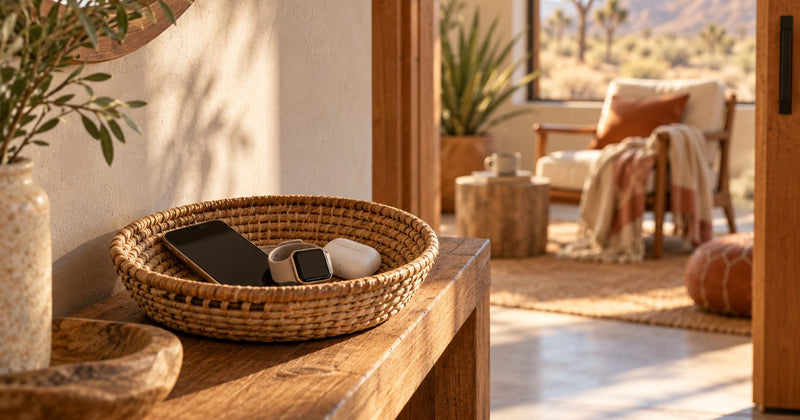
Most people end their day in the wrong kind of light. Bright overhead bulbs that match the color of office fluorescents, a phone screen pulsing blue light directly into the face, a TV in the background flickering at high intensity. By the time you’re trying to actually fall asleep, your body has been told for hours that it’s still daytime. So you lie down, close your eyes, and wonder why your mind won’t slow down.
The wrong kind of light is one of the most overlooked things in a sleep routine. And red light, of all things, is one of the simplest fixes.
This isn’t a piece about red light therapy as a treatment for anything. There’s a lot of writing online about red light and mitochondria, ATP, collagen, recovery, and the rest, and the science there is more mixed than the marketing usually admits. What we want to talk about is something simpler and more practical: red light as a signal. A behavioral cue. A way to tell your body that it’s getting close to sleep without saying it out loud.
What Red Light Actually Does
The honest version of the answer is that red light, at low brightness, doesn’t do much. And that’s the point.
For most of human history, the only light available after sundown was firelight. Warm, dim, and red-shifted. Our brains evolved expecting that the light around us would change color and intensity as the day ended. The body was supposed to read that shift and start preparing for sleep accordingly.
Modern light doesn’t do that. The overhead bulb in your kitchen at midnight looks the same as it did at noon. The screen in your hand has no opinion about what hour it is. The body’s evening cues never arrive, so the part of the brain that’s supposed to wind things down never quite gets the message.
A warm red lamp, used in the last hour before bed, isn’t claiming to heal anything. It’s just stepping in to do what firelight used to do. It changes the color of the room, dims the overall stimulation, and signals to the brain that the day is ending.
That’s the whole argument. It’s not “red light cures insomnia.” It’s “red light is the kind of light your body was expecting at this hour, and most modern rooms don’t have any of it.”
How to Actually Use It
A few practical notes on what works in real life.
Start about an hour before you want to be asleep. Earlier if you have a hard time winding down, later if you fall asleep quickly. The goal is to give your eyes and brain enough time to register the shift.
Use it as the only light in the room. A red lamp competing with an overhead bulb defeats the purpose. Turn off the overhead, dim or close the screens, and let the red be the dominant light source.
Pair it with something else slow. Reading a physical book, a quiet conversation, a stretch, getting ready for bed. Red light is environmental scaffolding for a wind-down routine, not the routine itself.
Don’t expect it to feel dramatic at first. The body needs a few nights of the same cue before it starts to anticipate. Most people who switch to red light at night describe a gradual shift, not a sudden one.
What’s Actually Worth Caring About
There’s a version of the red light conversation that’s full of claims: cellular respiration, mitochondrial function, performance recovery, brain optimization. Some of those claims are based on real (if narrow) studies, and others are extrapolations from those studies that wouldn’t survive a careful read.
For sleep specifically, the honest answer is more modest. Red light doesn’t make you sleep. It contributes to an environment that’s friendlier to sleep than the environment most people are actually in at 10 PM. That’s a smaller claim than the marketing usually makes, but it’s also a more durable one. You don’t have to believe anything mystical for it to work. You just have to set up the room and let your body do what it already knows how to do.
That’s how we think about it. Red light at night isn’t a treatment or a hack. It’s an environmental nudge. Worth trying for a couple of weeks if you’ve never seriously used it, especially if your current sleep environment is bright and screen-heavy.
Why We Built RŪBI
That’s the thinking behind RŪBI. We wanted a red lamp that did one thing well: throw a warm, low-stimulation light into the room at the end of the day, without trying to be three other things at the same time. No app. No smart home integration. No flashing modes or pulse settings or biohacking marketing. Just a real glass lamp, a single warm wavelength, and a simple touch to turn it on and dim it.
We built it for the same reason we built TŌNEM and SIBŌ. The wind-down should be quiet. The tools you use to wind down should be quiet too. The fewer of them that ping you, alert you, or ask you to make a choice, the better.
If you’ve been ending your nights in cold overhead light and a screen, give it a couple of weeks of the warm-and-dim version. The body remembers what it’s supposed to do.
From Pure Tone Therapy

RŪBI
Soft 670nm red light in a real glass lamp, with no blue or green light. Dims from a faint ember to a full glow.
$99.99
Shop RŪBIFree US shipping · 60 days risk-free with the Pure Tone Promise